
Product page SEO sits at the centre of ecommerce growth. It directly impacts your visibility, ranking, and conversion rates. Yet many ecommerce product pages struggle to perform because they miss key optimisation fundamentals.
This guide focuses on practical ways to optimise product pages, from URL structure to structured data. The goal is simple: help search engines understand your pages and help customers make decisions faster. When both align, SEO performance improves naturally.
Table of Contents
Understanding Search Intent for Ecommerce Product Pages
Search intent shapes how your product pages should be built. If your content does not match what users are actually searching for, rankings and conversion will suffer.
Most ecommerce product pages target transactional queries. These are users ready to buy or compare options. Your product description, product title, and page structure must reflect this intent clearly.
Navigational vs transactional intent in product pages
Transactional queries focus on action, such as “buy running shoes online”. Navigational queries often include brand or product name searches. Understanding this difference helps you optimise product pages for the right audience.
Mapping keywords to the buying journey
Not every keyword belongs on a product page. Broad queries may suit a category page, while specific product-related queries fit product detail pages. This improves both ranking and user experience.
How intent shapes product page structure and content
Pages should prioritise key information quickly. Product price, product image, and product specifications should appear early. This reduces friction and supports conversion.
Aligning product descriptions with real customer needs
Strong product descriptions answer real questions. They focus on benefits, use cases, and clarity rather than keyword stuffing. This improves both SEO and user experience.
Research from Baymard Institute shows that around 70% of online shopping carts are abandoned, often due to unclear product information.
Building an SEO-Friendly URL Structure
Your URL structure plays a foundational role in product page SEO. It helps search engines understand your website’s hierarchy while giving users a clear signal of what the page contains.
A well-optimised URL is simple, readable, and aligned with the product it represents. Poor structure can create duplicate content, waste crawl budget, and weaken SEO rankings.
A strong URL should:
- Be short and descriptive
- Focus on the product name
- Include a relevant keyword naturally
- Avoid unnecessary parameters or random strings
For example:
/mens-shoes/running-shoes/lightweight-trail-runner
This structure helps search engines understand relationships between products on your site while improving usability.
As your catalogue grows, consistency becomes critical. Organise URLs into logical categories and subfolders to support scalability.
To avoid SEO issues:
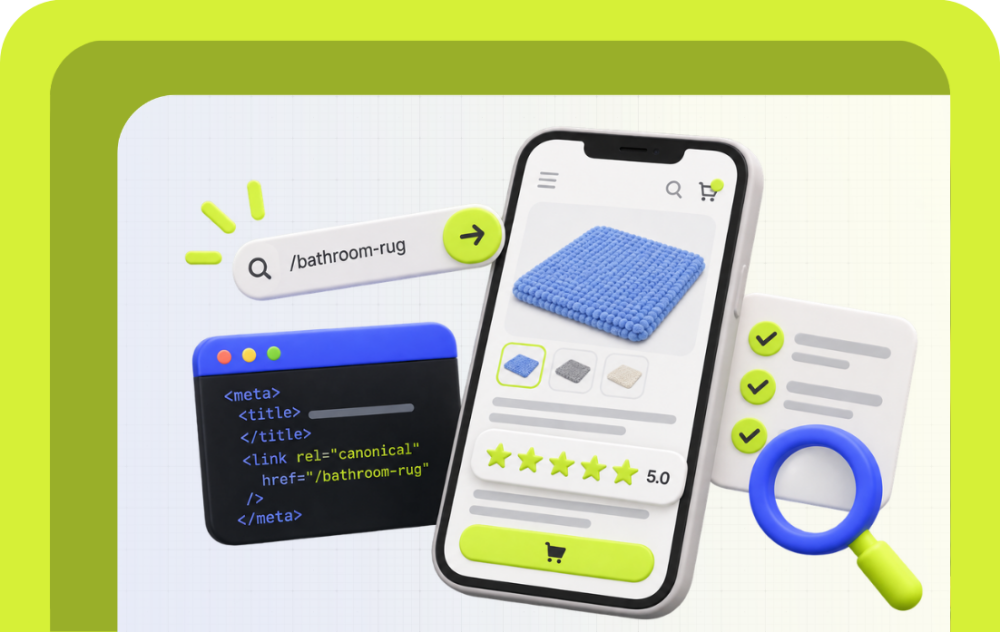
- Use canonical tags to control duplicate URLs
- Prevent indexing of filtered or parameter-based pages
- Maintain one clean, primary URL per product
A clear URL structure is not just technical. It directly supports visibility, indexing, and long-term SEO performance.
Technical SEO Essentials For Ecommerce Product Pages
Technical SEO ensures your product pages are accessible, fast, and easy for search engines to index. Even the best content will struggle to rank if your website’s technical foundation is weak.
For ecommerce sites, this becomes more important as your catalogue grows. Small technical issues can scale quickly and impact hundreds or thousands of product pages.
Crawlability and indexation fundamentals
Search engines need to discover and index your product pages before they can rank. This starts with a clean and well-maintained structure.
Make sure:
- Your XML sitemap includes all key product pages
- Important pages are not blocked by robots.txt
- Internal links connect your products on your site logically
Avoid creating orphan pages, as these are difficult for search engines to find and often fail to rank.
Managing duplicate content and product variants
Duplicate content is a common issue in ecommerce SEO, especially when dealing with product variants such as size or colour.
Instead of creating multiple competing URLs, use:
- Canonical tags to signal the preferred version
- Structured navigation to group variants under a single product
This helps consolidate ranking signals and improve SEO rankings for the main product page.
Improving page speed and performance
A fast page is critical for both user experience and SEO. Slow-loading product pages increase bounce rates and reduce conversion.
Focus on:
Compressing images and improving image SEO
- Reducing unnecessary scripts
- Using caching and a content delivery network (CDN)
Google considers page experience as a ranking factor, so improving load time will enhance SEO performance and user satisfaction.
Mobile optimisation and technical usability
Mobile usability is no longer optional. Most ecommerce traffic now comes from mobile devices, and your product pages must perform well on smaller screens.
Ensure your pages:
- Load quickly on mobile networks
- Display key information clearly without scrolling
- Have easy-to-use navigation and buttons
A well-optimised mobile experience supports both SEO rankings and conversion.
Once your technical foundation is in place, the next step is focusing on how your product pages perform for users
What Makes a High-Performing Product Page
A high-performing product page does two things well. It helps search engines understand the page, and it helps customers make a confident decision. If either side is weak, your SEO performance and conversion will suffer.
Clear product titles that match search queries
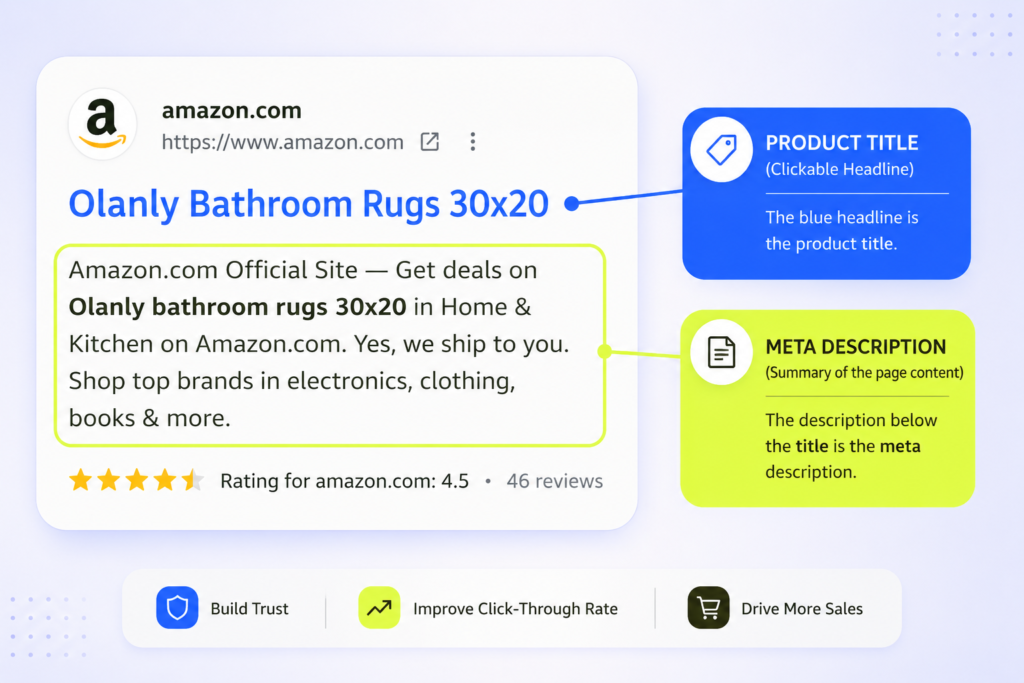
Your product title should reflect how people actually search. Search engines rely heavily on titles to interpret relevance, so clarity here directly impacts ranking.
For example, instead of:
- “Model X200 Jacket”
Use:
- “Men’s Waterproof Hiking Jacket – Lightweight and Windproof”
Google’s own guidance highlights that descriptive, accurate titles help both visibility and user understanding in search results.
High-quality product images that support decision-making
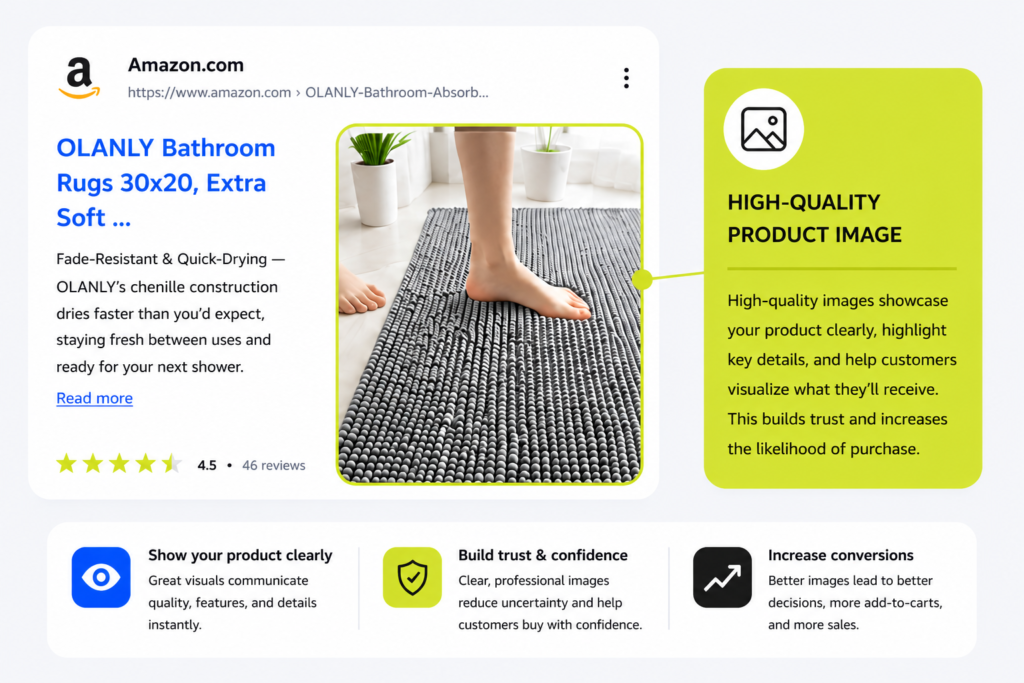
Images play a critical role in ecommerce because they replace the in-store experience. When users cannot physically interact with a product, visuals must do that work.
Include multiple angles, close-ups, and real-life usage. For example, a backpack should show internal compartments, not just the exterior. Studies show that around 75% of online shoppers rely on product images when making purchase decisions. If your visuals are limited or unclear, you are effectively removing a key decision factor.
Compelling product descriptions that drive conversion
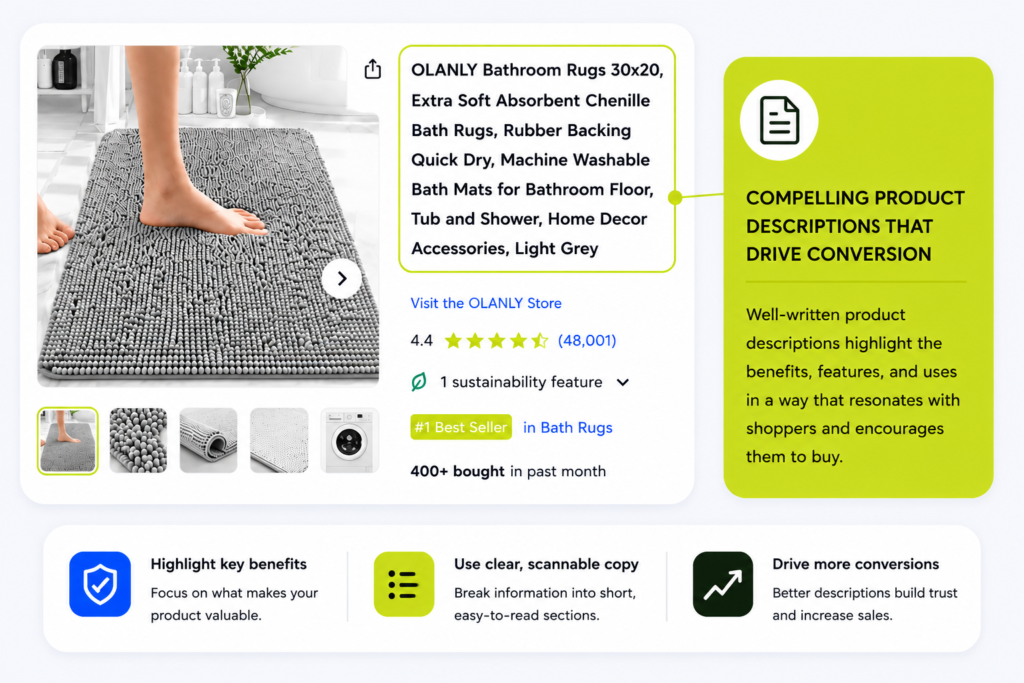
A strong product description should explain why the product matters in real use.
Weak example:
- “Made from durable material with adjustable straps.”
Improved version:
- “Built with water-resistant fabric and adjustable straps, this backpack stays comfortable on long hikes and protects your gear in unpredictable weather.”
Research from Salsify shows that the majority of consumers consider product content one of the most important factors in their buying decision. Your description is not supporting content but it is a conversion driver.
Transparent pricing and availability information
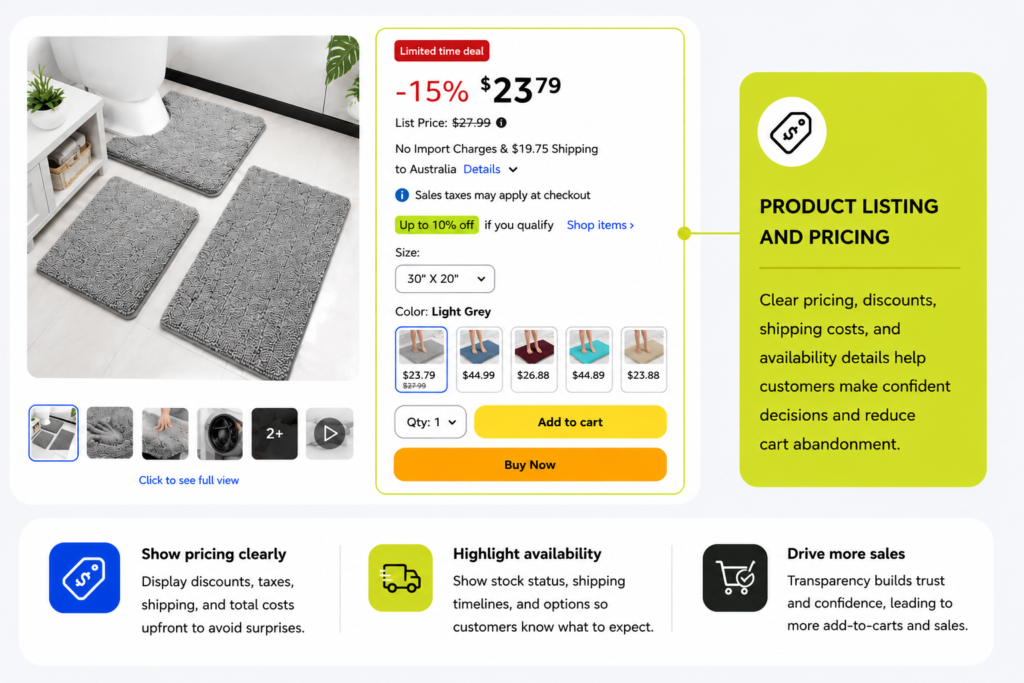
Users expect immediate clarity on price, stock status, and delivery timelines. If they can’t find this information quickly, they often hesitate, continue comparing options, or leave the site altogether.
In this example, the product page clearly displays the price and available sizes, helping shoppers make faster purchase decisions with confidence.
For example:
- “In stock – delivery within 2–3 days”
This type of upfront information reduces uncertainty and reassures customers that the product is available and can be delivered within a reasonable timeframe.
Baymard Institute research shows that unexpected costs are the leading cause of cart abandonment. Clear, upfront pricing reduces that risk and keeps users moving forward.
Strong calls to action that reduce friction
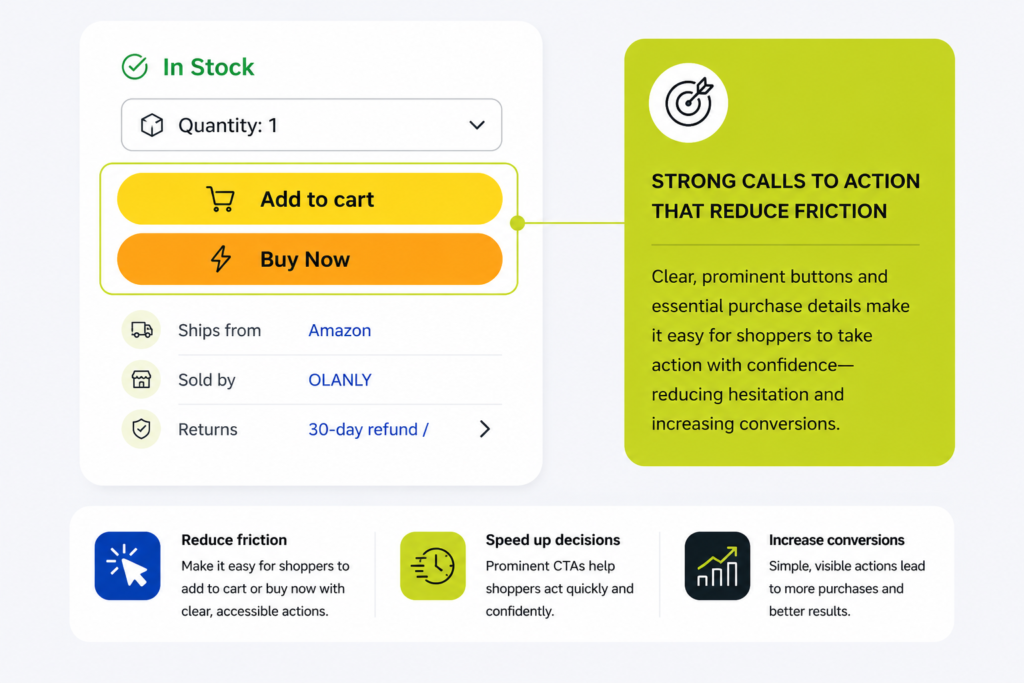
Your call to action should make the next step obvious. Avoid vague labels like “Submit” or “Continue”.
Use:
- “Add to basket”
- “Buy now”
Placement also matters. The CTA should be visible early, especially on mobile.
Trust signals such as reviews and ratings
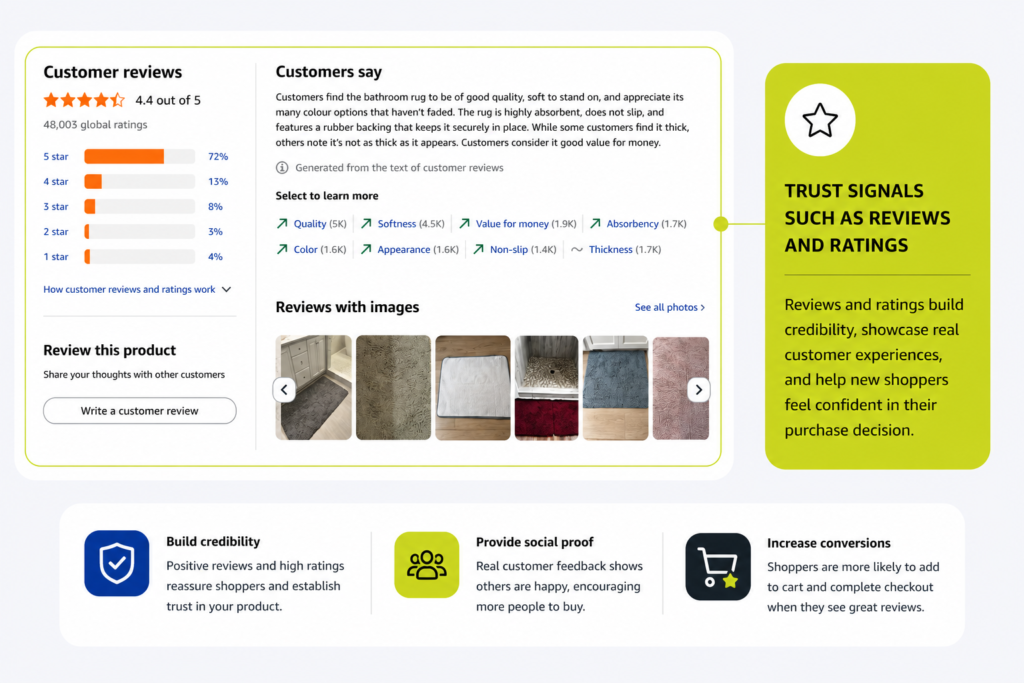
Trust is often the deciding factor on ecommerce product pages. Reviews, ratings, and customer feedback help users validate their decision.
Display ratings near the product title and include detailed reviews where possible. This has a direct behavioural impact. Without them, even well-optimised product pages can struggle to convert.
Mobile-friendly layout and usability
Mobile traffic now dominates ecommerce, so your product pages must be designed for smaller screens first.
Ensure:
- Buttons are easy to tap
- Text is readable without zooming
- Key content appears early
With more than half of ecommerce traffic coming from mobile devices, poor mobile usability does not just affect user experience, it directly limits your potential revenue and SEO performance.
Fast loading speed and technical performance
Speed is a core part of both SEO and conversion. A slow page creates friction before users even engage with your content.
Research from Akamai shows that even a one-second delay in page load time can reduce conversions. Google also factors page experience, including load time, into ranking decisions, making speed a dual priority.
Internal linking to related products and categories
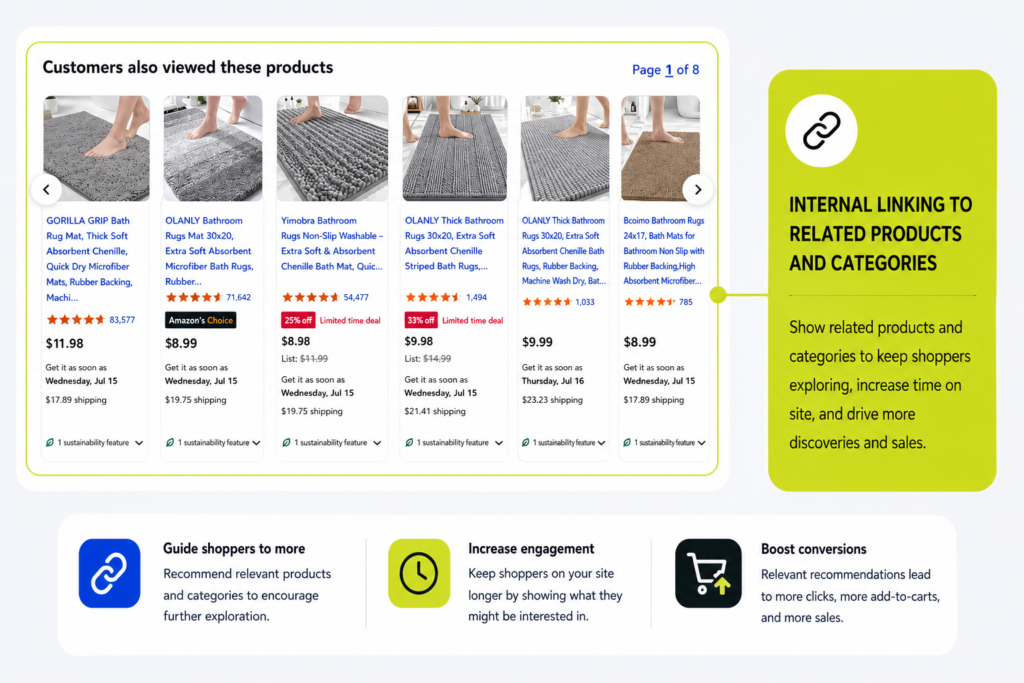
Internal links help users discover more products while signalling relationships to search engines.
For example:
- “You may also like”
- “Customers also bought”
This keeps users engaged and improves SEO by strengthening your internal link structure. It also increases the likelihood of higher order values.
Clear product specifications and key details
Users should not need to search for important information. Present product specifications in a clear, scannable format.
Include:
- Size and dimensions
- Materials
- SKU
- Product variants
This reduces uncertainty and helps users make faster decisions, particularly for technical or high-value products.
Visual hierarchy that guides user attention
Structure your page so users naturally focus on the most important elements first.
A strong layout typically follows:
- Product title and price
- Images
- Key benefits
- Product description
- Supporting details
This approach mirrors how users scan web pages and improves both engagement and conversion.
FAQ or expandable content for additional queries
Customers often have similar questions before buying. Answering these directly on the page reduces friction.
Examples:
- “Is this product waterproof?”
- “What size should I choose?”
This also helps capture long-tail search queries, improving your visibility across a wider range of searches.
User-generated content integration
User-generated content adds authenticity that brand-written content cannot replicate.
Include:
- Customer reviews
- User photos
- Real usage examples
This not only builds trust but also adds fresh, natural language content to your product pages, which supports SEO over time.
Schema markup for enhanced SERP visibility
Structured data helps search engines understand your product pages more clearly. It also enables enhanced listings in search results.
Use:
- Product schema
- Review schema
- Offer schema
When implemented correctly, this can result in rich results such as star ratings and pricing appearing directly in Google search. These enhanced listings often attract more attention and improve click-through rates.
Accessibility considerations for all users
Accessible design improves usability for everyone, not just specific user groups.
Key actions:
- Use descriptive alt text
- Ensure strong colour contrast
- Structure content with clear headings
These improvements align closely with SEO best practices, as they help search engines interpret your content more effectively.
Consistent branding across ecommerce product pages
Consistency builds familiarity and trust. Your product pages should feel like part of a cohesive experience.
Maintain:
- A consistent tone of voice
- Clear and predictable layout
- Unified messaging
When users feel confident in your brand, they are more likely to complete a purchase.
A well-optimised product page is not about ticking boxes. It is about removing friction at every step. When your page clearly explains the product, builds trust, and performs well technically, both visibility and conversion improve naturally.
How to Optimise Product Descriptions for Search and Conversion
Product descriptions sit at the intersection of SEO and conversion. They help search engines understand your product pages, but more importantly, they influence whether a visitor becomes a customer.
Many ecommerce businesses still treat product descriptions as a secondary task. In reality, they are central to both SEO performance and revenue. Research from Salsify’s 2023 Commerce Experience Index (CXI) shows that 87% of shoppers consider product content a critical factor in their purchase decisions.
Writing unique product descriptions at scale
One of the most common SEO issues in ecommerce is duplicate content. Many product pages reuse manufacturer descriptions, which appear across multiple websites. This makes it difficult for search engines to decide which page to rank.
To optimise your product pages effectively, focus on context and intent rather than volume. Each product description should answer a specific search query and clearly explain who the product is for.
For example, instead of describing a single product as “high-quality wireless headphones”, break it down by use case:
- Designed for remote workers needing clear audio on calls
- Suitable for gamers who need low latency performance
- Ideal for travellers who need long battery life
This approach helps search engines understand relevance while making your content more persuasive. It also supports broader ecommerce SEO by targeting multiple search queries within one well-optimised product page.
Using AI to support product description optimisation
AI is becoming a core part of modern ecommerce SEO as it can speed up content creation. However, the real value of AI is not in replacing human input but to accelerating it. A more effective approach is to treat AI as a starting point, not the final output.
For example, an AI-generated description for a “wireless gaming mouse” might look like this:
- “High-performance wireless mouse with ergonomic design and long battery life.”
While technically accurate, it does not answer real buyer questions. It lacks context, use cases, and differentiation.
A stronger, human-refined version would build on this by adding insight:
- “Designed for competitive gamers, this wireless mouse offers ultra-low latency performance and up to 70 hours of battery life, making it ideal for long sessions without interruptions.”
You are not just describing the product but you are helping the user decide.
To make this scalable across ecommerce product pages, try to follow this structured process:
- Use AI to generate a structured draft
Start with the product name, key features, and target keyword. This creates a consistent baseline across your catalogue. - Refine with real product knowledge
Add insights your customers actually care about. For example, highlight durability for outdoor gear or comfort for wearable products. - Incorporate customer language and queries
Pull phrasing from reviews or search queries. If customers frequently ask “Is this suitable for travel?”, answer that directly in the description. - Add comparisons and alternatives
Position the product clearly. For example: “Compared to standard models, this version offers quieter operation and improved energy efficiency.” - Include practical use cases
Help users visualise the product in real situations. This improves engagement and conversion.
Image optimisation and alt text best practices
Images are a core part of ecommerce product pages, but they also play a role in search engine optimisation when properly implemented.
To optimise effectively:
- Use descriptive file names (e.g. “black-leather-wallet.jpg”)
- Add clear alt text that accurately describes the product
- Compress images to maintain a fast page load time
This is not just a technical recommendation. Google’s own Search Central documentation on image SEO explains that alt text helps search engines understand visual content and improves accessibility.
For ecommerce sites, this can improve visibility in both standard search results and image-based queries.
Avoiding duplicate manufacturer content
When multiple ecommerce product pages use the same description, search engines may prioritise more authoritative domains. This leaves smaller or newer websites struggling to gain visibility.
To improve the SEO of your product pages:
- Rewrite and expand on manufacturer descriptions
- Add unique insights, such as product comparisons or FAQs
- Include user-generated content like customer reviews
Structuring descriptions for readability and SEO
Even the most informative product description will fail if users cannot quickly scan it. Most visitors do not read product pages in full. They look for key details first.
A well-optimised structure helps both users and search engines understand your content.
Best practice structure for product descriptions:
- A short summary that clearly describes the product
- Bullet points highlighting key features and benefits
- A deeper section explaining real-world use and value
This structure improves engagement and supports technical SEO by making content easier to interpret.
Using keywords naturally without over-optimising
Keyword usage should feel natural and aligned with how customers search. Overusing exact-match terms can harm both readability and SEO performance.
Focus on:
- Including the primary keyword in key areas such as the product title
- Using related terms throughout the content
- Writing for clarity first, then refining for SEO
- Highlighting benefits instead of just features
Features describe the product, but benefits explain why it matters. This distinction is critical for conversion.
For example:
- Feature: “5000mAh battery”
- Benefit: “Provides up to two days of use without charging, making it ideal for travel or long workdays”
This shift aligns your content with how customers think. They are not evaluating specifications alone but they are assessing whether the product solves their problem.
Formatting content for scannability and engagement
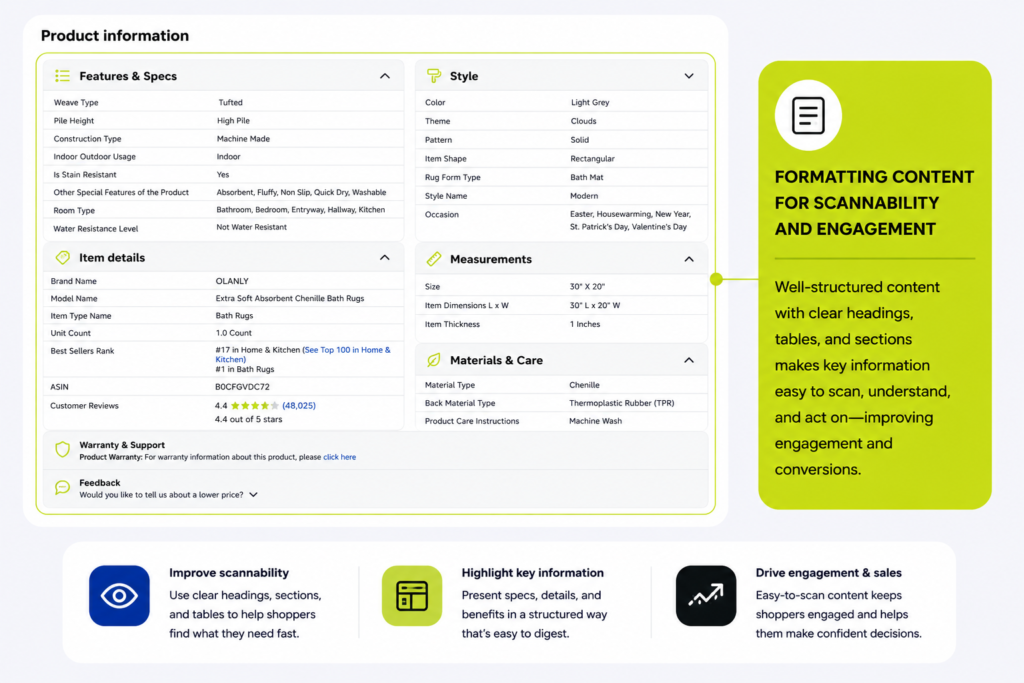
A well-optimised product page should be easy to scan within seconds. This improves both user experience and SEO performance.
Quick checklist to optimise your product descriptions:
- Use short paragraphs (1–3 sentences)
- Break up content with bullet points
- Highlight key benefits early
- Keep important details above the fold
This structure reduces friction and increases engagement, which can positively influence metrics like time on page and organic traffic.
Make your product pages convert better
Where to focus first for the biggest impact
If you want to improve the SEO of your ecommerce product pages quickly, prioritise the elements that influence both ranking and conversion.
Start with these high-impact areas:
- Optimised title tags aligned with search queries
- Unique, benefit-driven product descriptions
- Strong internal linking to related and similar products
- Fast-loading pages with optimised images
Focusing on these areas will help you improve the SEO, enhance visibility, and create a well-optimised product page that performs consistently in Google’s search results.
Leveraging Structured Data for Rich Results
Structured data is one of the most effective ways to improve how your product pages appear in search. It helps search engines understand your content more clearly and enables enhanced listings known as rich results.
What structured data means in practice
Structured data uses schema markup to describe key product details in a format search engines can easily interpret. Instead of guessing what your page contains, search engines can clearly identify elements like product price, availability, and customer reviews.
What to include on ecommerce product pages
To optimise product page SEO effectively, focus on the core schema types that directly impact visibility:
- Product schema: Defines the main product, including name and description
- Offer schema: Includes price, currency, and availability
- Review schema: Displays ratings and customer feedback
When combined, these elements help create richer, more detailed search listings that stand out in competitive results.
How to test and improve your markup
Once implemented, always test your structured data to ensure it works as expected.
Use:
- Google’s Rich Results Test
- Schema validation tools
These tools highlight errors and show whether your page is eligible for rich results. This step is often overlooked, but it is critical for maintaining SEO performance.
Common Product Page SEO Issues And How To Fix Them
Even well-designed product pages can underperform due to common SEO issues. Identifying and fixing these problems is often the fastest way to improve visibility and organic traffic.
Thin or low-quality product content
Many ecommerce sites rely on minimal descriptions or duplicate content. This limits your ability to rank and reduces trust with users.
How to fix it:
- Write unique, keyword-rich product descriptions
- Expand content with FAQs, specifications, and use cases
- Focus on clarity and relevance rather than word count
A well-optimised product page should provide enough detail to fully describe the product and answer key questions.
Poor internal linking and site structure
If your product pages are not well connected, search engines struggle to understand their importance.
How to fix it:
- Link to related and similar products
- Connect product pages to relevant category pages
- Ensure no important pages become orphan pages
This improves crawlability and distributes authority across your website’s structure.
Weak keyword targeting and search intent mismatch
Targeting the wrong keyword or ignoring search intent can prevent your pages from ranking.
How to fix it:
- Focus on keywords aligned with buying intent
- Ensure your content matches the user’s search query
- Avoid overloading pages with irrelevant terms
This helps make your product pages more relevant and improves SEO rankings.
Slow page load times and poor performance
Performance issues can significantly impact both ranking and conversion.
How to fix it:
- Optimise images and reduce file sizes
- Improve server response times
- Minimise unnecessary scripts
A fast page improves user experience and supports better SEO performance.
Missing or incorrect structured data
Without structured data, your product pages miss opportunities for enhanced visibility in search.
How to fix it:
- Use structured data for product, offer, and review information
- Validate your markup regularly
- Ensure consistency between visible content and schema
This helps search engines understand your pages and improves eligibility for rich results.
How To Scale Product Page SEO With AI And Automation
As your ecommerce catalogue grows, manual optimisation becomes difficult to maintain. Scaling product page SEO requires a structured approach that combines AI with clear processes.
The goal is not just speed, but consistency. Every product page should meet the same standard of quality.
Where AI adds the most value
AI can support large-scale optimisation without sacrificing quality when used correctly.
Use AI to:
- Generate initial product descriptions
- Identify keyword opportunities and gaps
- Group products into categories and clusters
This helps you optimise your product pages faster while maintaining relevance.
Building scalable workflows for ecommerce teams
To scale effectively, you need repeatable processes that can be applied across all products on your site.
A simple workflow might include:
- Template-based product descriptions
- Standardised heading and content structure
- Defined rules for keyword usage and formatting
This ensures every page follows best practices and remains good for product page SEO.
Maintaining quality while automating
Automation should never come at the expense of quality. Purely automated content often lacks the depth needed to perform well.
To maintain a high standard:
- Review and refine AI-generated content
- Add human insights and real-world context
- Regularly audit your pages for SEO issues
This balance helps you enhance SEO while keeping your content useful and trustworthy.
Using automation for technical SEO improvements
Automation can also support technical SEO at scale.
For example:
- Automatically update XML sitemaps
- Monitor broken links and indexing issues
- Identify pages with poor performance
These improvements help maintain a well-optimised product ecosystem as your site grows.
How Can You Make Your Product Pages Work Harder?
Optimising product pages is not about one change. It is about building a system that supports visibility, usability, and conversion over time.
When you combine strong product descriptions, clean technical SEO, and consistent optimisation, you create a well-optimised product experience that performs across every stage of the buying journey.
If your current product pages are not delivering the results you expect, it may be time to take a more structured approach. At Webfuel Digital , we help ecommerce businesses optimise their product pages, improve SEO rankings, and drive measurable growth.
If you need support with product page SEO or want to enhance your current strategy, get in touch with our team to see how we can help.